Neighborhoods


Strategic Neighborhood Transformation

Sidebar images:
, ,
Body:

Monday, December 3, 2018

The work of the Youngstown Neighborhood Development Corporation is highlighted in an article titled "How to Fight Vacancy? Do It All" in the November edition of Shelterforce magazine.

The YNDC team wrote the article at the request of Shelterforce, which is is an independent publication of the National Housing Institute that serves (and sometimes challenges) community development practitioners across the United States. The article can be read here.

Sidebar images:
Body:

Thursday, December 6, 2018

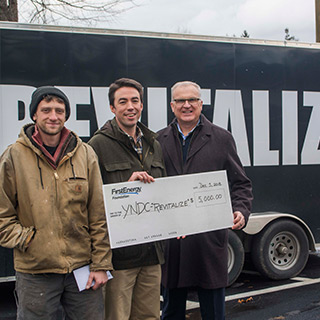
On Wednesday, December 5, the FirstEnergy Foundation awarded a $5,000 grant to YNDC for Corridor Improvement Corps. 

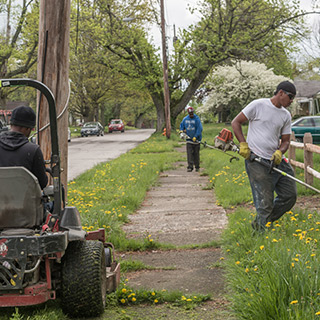
The Corridor Improvement Corps is a comprehensive revitalization strategy aimed at improving public health, safety, and quality of life for residents by leveraging AmeriCorps members and community volunteers to complete physical improvements to Youngstown’s neighborhood corridors. The improvements will include 1) cleaning up and painting blighted walls and facades of vacant buildings, 2) cleaning up and clearing overgrowth from vacant lots littered with debris, 3) planting hearty urban trees, 4) installing split rail fencing along vacant lots, 5) replacing broken and unsafe sidewalks, 6) installing covered benches at public spaces and bus stops, and 7) improving corridor lighting and signage around public spaces and corridor businesses. When applied systematically, these improvements will restore a basic sense of order to Youngstown’s corridors and will result in sustainable improvements to the safety and quality of life for Youngstown’s residents. Many thanks to the First Energy Foundation for the support! REVITALIZE.

Sidebar images:
Body:

A group of West Side residents hopeful that a house they consider a nuisance would transfer into possession of the Mahoning County Land Bank saw its hopes dashed after a last-minute redemption kept the property in the hands of its current owners.

It’s a scenario that has played out many times before: The county moves to foreclose on a property – oftentimes vacant properties with absent owners, but not always – and the property owner makes a deal to either pay the back taxes or establish a payment plan.

Though the system is meant to ensure that individuals have options to negotiate with the county and forestall the loss of their homes in the event they owe back taxes, the system is indiscriminate in the home- owners they protect.

The owners of 345 S. Hazelwood Ave., New York-based Canus Investments, use the home as a rental property. The investment group reached an agreement with the county in September to address its $3,258 in delinquent taxes.

The house has sat vacant for more than a year, however, and neighbors want to see something happen with the structure. To read the full story from The Vindicator, click here. 

Sidebar images:
Body:

Youngstown council's community planning and economic development committee met with concerned citizens to consider legislation to address predatory land contracts on Monday.

Council said recently the city has experienced an increase in out of town and out of state property owners buying property.

They also said this is a way for owners to take advantage of residents and blight the neighborhoods. To read the full story from WFMJ, click here.

Sidebar images:
Body:

The first reading of the legislation is slated for the beginning of January.

"This is a serious problem we need to address in our neighborhoods," said Jack Daugherty, a community leader.

Daugherty was among several community members who sat in on the meeting.

"People sometimes end up paying seven to 20 times what the house is actually worth through these land contracts," Daugherty said.

In these contracts, the hopeful homeowners end up paying more because of inflated interest rates. They also are not given protections like you would through a traditional mortgage.

"So, they create these very confusing contracts that are very hard to follow that intentionally prey upon people and exploit them," Daugherty said. To read the full story from WKBN, click here.

Sidebar images:
Body:

The campaign led by city activists to end predatory land contracts took a small step forward Monday night during a meeting of Youngstown’s Housing, Community and Economic Development committee.

City Prosecutor Dana Lantz presented the committee with a rough draft of an upcoming piece of legislation that would give the city the authority to require interior and exterior inspections of a property before it could be sold using a land-installment contract.

Members of the Alliance for Congregational Transformation Influencing our Neighborhoods (ACTION) and various neighborhood organizations attended the meeting and have largely led the local charge against land-contract companies. The groups have been working to see a piece of legislation introduced to city council since October.

After Lantz and Patricia Dougan, a lawyer with Community Legal Aid, revise the current draft, the legislation will go before council for a first reading the first week of January. After that, the legislation will be brought before ACTION members and other activists who will be able to review it and ensure it addresses their concerns, after which it will proceed to second and third readings, with a potential passage sometime in mid-to-late February.

Lantz said the city would have to train inspectors to conduct both interior and exterior inspections, but that noncity inspectors could be used by prospective home vendors so long as they are approved by the city. She emphasized that for such an inspection program to exist, it would have to be financially self-sustaining.

The current legislation only addresses land-installment contracts. Rent-to-own land contracts will be the next piece of legislation the city and activist groups aim to pass.

Under rent-to-own land contracts, prospective owners pay rent to a seller for a predetermined number of years before having the option to purchase the property. To read the full story from The Vindicator, click here. 

Sidebar images:
Body:

Julius Bennett is a lifelong resident of Youngstown who grew up on a family farm on the East Side and has lived in the Idora Neighborhood for over 40 years.

He has served on the boards of the Associated Neighborhood Center, Southside Ministries, and the United Methodist Community Center. He currently serves as a board member of the Mahoning Valley Historical Society and is actively involved at Tabernacle Baptist Church.

Sidebar images:
Body:

Phil Kidd is the director of Vibrant Neighborhoods for the Cleveland Foundation. He previously served in the Mayor's Office of Capital Projects for the City of Cleveland and as the Special Project Manager for Northwest Neighborhoods CDC on the west side of the city.

In Youngstown, Phil served as the City of Youngstown Director of Events & Special Projects; Senior Organizer with the Mahoning Valley Organizing Collaborative; Staff Consultant for the YSU Journalism Department; Associate Director of Youngstown CityScape and; was owner of Youngstown Nation and author of the blog, Defend Youngstown.

Mr. Kidd was also a co-founder of the former City Club of the Mahoning Valley and is a Community Affiliate with the YSU Center for Working Class Studies.

He has a Masters Degree from Youngstown State University in Criminal Justice. His thesis focused on the effect of neighborhood-based community development's impact on crime in older industrial cities by way of a case study of YNDC's efforts in the Idora neighborhood. He also has Graduate Certificate in Local Government Management from Cleveland State University.

He is a graduate of PICO Community Organizing Weeklong Training; Cleveland Neighborhood Leadership Institute's Community Facilitator Training; Racial Equity Institute Training; Leadership Mahoning Valley; and the Mahoning Valley Local Government Leadership Academy.

Sidebar images:
Body:

LOCAL TOPICS ON TV

“A Conversation with Dee” (Sunday at 7:30 a.m. on WYTV-TV): Host Dee Crawford talks with officials from the Youngstown Neighborhood Development Corporation about the work they’ve done over the past year and the neighborhoods and projects they are targeting for next year. To read the full story from The Vindicator, click here. 

Sidebar images:
Body:

The power of persistence and partnerships paid off prodigiously for Youngstown and the Mahoning Valley this week.

On Tuesday, Elaine L. Chao, secretary of the U.S. Department of Transportation, formally announced in Washington that a consortium of Valley institutions will be awarded a $10.85 million infrastructure improvement grant from the Better Utiliizing Investments to Leverage Development [BUILD] program.

The significance of that award cannot be overstated. The Youngstown proposal stands out as the one and only urban BUILD application among many from Ohio that received funding in the program this year. It also stands out as among only 91 projects to get the green light out of 851 applicants seeking $10.9 billion nationwide.

The top-tier quality of the Youngstown proposal drew special attention from Chao and other U.S. DOT brass as the only federal BUILD grant recipient to receive a special invite to attend Tuesday’s official announcement ceremony. Youngstown Mayor Jamael Tito Brown was among the honored attendees.

From our perspective, however, we’ve known for several years now that the project proposal stood out with singular supremacy. Essentially the same project had sought DOT funding each year since 2016 but missed the cut by a hair each time. This year’s proposal, with some added tinkering, clearly stood out as having all the right stuff.

First, elements of the city’s SMART2 [Strategic & Sustainable, Medical & Manufacturing, Academic & Arts, Residential & Recreational, Technology & Training] proposal fully meet the principal criteria for BUILD funding. The major elements of SMART2 focus squarely on road and public transportation improvements. The total $26.2 million project to renovate and modernize downtown Youngstown and the Fifth Avenue corridor does just that.

The grant proposal calls for putting Fifth Avenue on a so-called “road diet,’ reducing it from six lanes to a divided boulevard with a landscaped median and one traffic lane on each side.

Other major structural and aesthetic enhancements are planned for major downtown streets including Federal, Commerce, Phelps and Front.

New to this year’s grant is a component that strengthens the all-important public-transportation dimension. It calls for activating autonomous driverless shuttle vehicles to connect the Mercy Health medical campus, Youngstown State University, the downtown central business district and the new chill-can plant and research campus operated by Joseph Co. International on the city’s East Side.

In those and other respects, the proposal meets and beats the areas under evaluation. They include safety, economic competitiveness, quality of life, environmental protection, energy independence, innovation and community partnerships. To read the full story from The Vindicator, click here.