Neighborhoods


Strategic Neighborhood Transformation

Sidebar images:
Body:

The public is invited to the February monthly meeting of the Powerstown Block Watch from 7 to 8 p.m.

Thursday at Faith Community Covenant Church located at Midlothian and Sheridan boulevards. Guest speaker will be a representative from the Youngstown Neighborhood Development Corp. To read the story from The Vindicator, click here. 

Sidebar images:
Body:

Now that land contracts are being regulated in Youngstown, the community group ACTION (Alliance for Congregational Transformation Influencing Our Neighborhoods) is focusing on the city as a food desert.

Youngstown defines "food desert" as an area more than a mile from a grocery store -- but distance may not be the number one reason low-income people aren't buying fruits and vegetables.

The term itself, at least in Youngstown's case, may be misleading. "Food desert" makes it sound like there are no grocery stores available, which is not the case. There are four -- one on each side of the city.

"We believe the primary impediment to that is cost," said Ian Beniston, with the Youngstown Neighborhood Development Corporation (YNDC).

Along with cost, other factors are education, transportation and access.

Rose Carter, with ACTION, said starting in May, there will be pop-up markets around Youngstown, similar to one in June of last year at the B&O Station downtown. To read the full story from WKBN, click here. 

Sidebar images:
Body:

Blockwatch meeting

YOUNGSTOWN

The public is invited to the February monthly meeting of the Powerstown Block Watch from 7 to 8 p.m. Thursday at Faith Community Covenant Church at Midlothian and Sheridan boulevards.

Guest speaker will be a representative from the Youngstown Neighborhood Development Corp. To read the full story from The Vindicator, click here. 

Sidebar images:
Body:

Wednesday, February 13, 2019

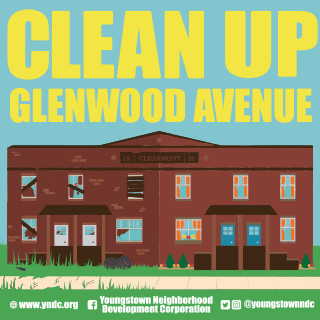
On Wednesday, February 13, the Fibus Family Foundation awarded a $5,000 grant to support Clean Up Glenwood Avenue, a program aimed at systematically cleaning up and transforming Glenwood Avenue and its adjacent neighborhoods into a safe, stable community with a vibrant corridor that provides a high quality of life and economic opportunity for residents.

All aspects of the program align with priorities set forth in resident-driven neighborhood plans and include the clean up of  vacant properties, improvement of unmaintained vacant lots, installation of LED lighting at key locations and crossings to improve pedestrian safety, and replacement of broken sidewalks on the streets surrounding Glenwood Community Park, which serves thousands of youth each year. As part of a broader neighborhood revitalization strategy, these improvements have begun to reduce crime and tax delinquency while restoring homeownership, property values, and pedestrian safety. Many thanks to the Fibus Family Foundation for their support! 

Sidebar images:
Body:

Friday, February 15, 2019

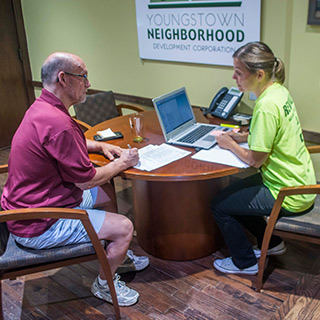
Farmers National Bank has awarded YNDC with a $5,000 grant that will benefit the HUD-approved Housing Counseling Program.

The Housing Counseling Program assists clients with identifying and resolving the barriers to homeownership in one-on-one counseling sessions. Thank you to Farmers for their ongoing support!

Sidebar images:
Body:

For many decades now, The Vindicator has lamented Youngs-town’s ignominious reputation as a hotbed of serious crime.

Take murder, for example. Its stain has been long-standing – from the label of “Murdertown USA” affixed to the city by the Saturday Evening Post in the early 1960s through the high-casualty gang wars of the 1990s and into the present, when Youngstown’s homicide rate, though stabilizing in recent years, still ranked about four times above the national average in 2018. Similarly, Youngstown’s reputation as a leading breeding ground for destructive intentionally-set fires has long been common knowledge. In fact, in a report from 2016 on the decline of Rust Belt cities, the Washington Post called Youngstown “the nation’s arson capital.” Fortunately, however, that shameful and despicable moniker no longer sticks. As Vindicator Police Reporter Joe Gorman wrote this week in a Page 1 story, the number of arsons in Youngstown has dipped dramatically. To wit, the number of intentionally-set fires in vacant structures throughout the city declined about 300 percent between 2015 and 2018 from 196 to 61, according to the city fire department’s recent annual report on arsons. In vehicle arsons, the decline has been even more dizzying. In the one-year span from 2017 to 2018, the number of such arsons fell from 100 to 30, another amazing threefold fall. Credit for these positive and promising trends goes to all individuals, entities and agencies working to lessen the city’s landscape of blighted properties. One major factor in the decline has been the intensified fervor in demolishing vacant buildings. Thanks to the concerted efforts of the city’s blight remediation and street departments, the Mahoning County Land Bank, private contractors and others, about 1,750 houses have been razed in all four quadrants of the city over the past three years alone. “The demolition people are ... getting the houses down pretty quick. The number [of vacant homes] is getting smaller and smaller,” said YFD Chief Barry Finley. His department, too, must share in the credit for the optimistic trend through its professional and rapid response to such fires during a time in which overall calls to the department skyrocketed from 3,113 in 2017 to 4,338 in 2018.

FEWER OPPORTUNITIES

As a result of these cooperative initiatives, firebugs have had fewer and fewer opportunities to ply their nefarious trade. In addition, successes by the land bank and the Youngstown Neighborhood Development Corp. in restoring scores of once unlivable homes and injecting new pride into many neighborhoods have made increasingly large tracts of the city far less susceptible to arson and other crimes. To read the full story from The Vindicator, click here. 

Sidebar images:
, , , , , , , ,
Body:

Monday, February 18, 2019

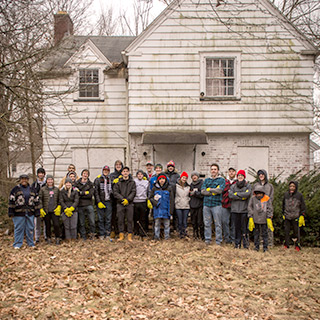
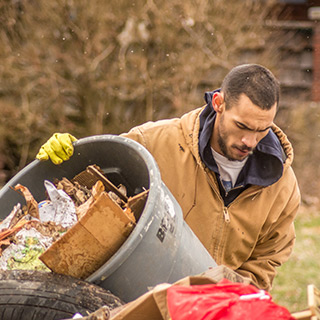
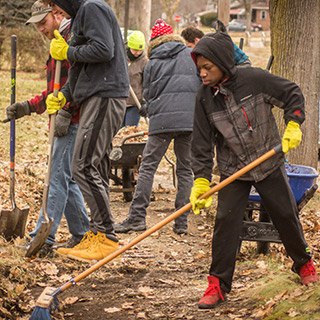
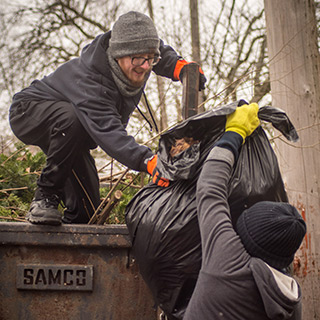
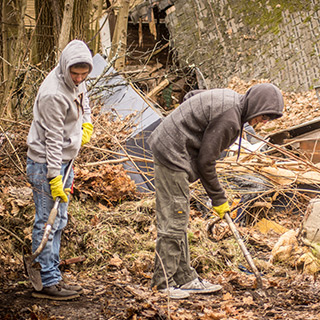
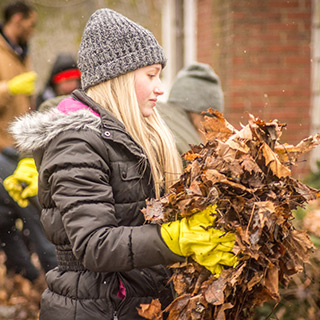
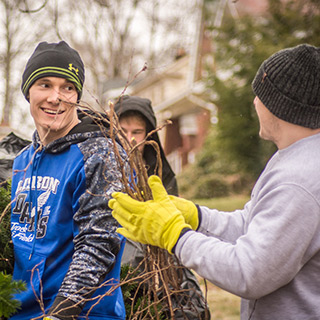
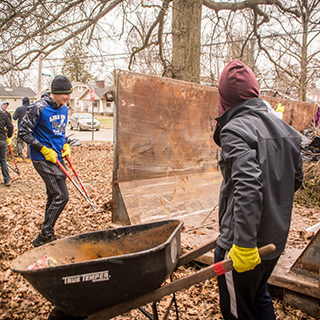
On Saturday, February 16, thirty volunteers helped clean up vacant properties at the Newport Neighborhood Workday.

Neighborhood residents, along with volunteers from YSUscape and the YSU Honors College removed 18 illegally-dumped tires, 40 cubic yards of brush and debris, installed 13 LED security lights, reclaimed 250 linear feet of sidewalk, and secured one vacant home. We would like to thank all the volunteers for their hard work and Sixth Ward Councilwoman Anita Davis, who attended and spoke with volunteers and expressed her gratitude for the progress being made in the Newport Neighborhood. We would also like to thank to Mocha House for graciously supplying coffee and hot chocolate for the volunteers.

Sidebar images:
Body:

Private companies invested more than $173 million in the Mahoning Valley last year, many with the help of regional economic development agencies, the Youngstown/Warren Regional Chamber reports.

According to data compiled by the Regional Chamber and its economic development partners, and published in the 2018 Economic Development Report Card, a total of 102 projects resulted in $173,364,100 invested, 1,157 new jobs and another 3,271 retained jobs.

That compares to 367 company projects resulting in $216,256,009 of investment and 926 new jobs in 2017.

Economic development agencies assisted with 75 projects in 2018, resulting in more than $155 million in investment, creation of 1,016 jobs and retention of 2,914 jobs, according to the report card.

The Regional Chamber, in partnership with 15 other agencies, gathers data on economic development investment in the valley annually. The entities’ combined resources assist companies with infrastructure investment, tax incentives, loans, project coordination, grant oversight, technical advisement, property development and other services. Each individual agency provides project investment for business attraction, retention/expansion and/or startup; job creation/retention; and notable activity that occurred within its reporting year.

The collective efforts of the agencies are screened for duplication and then presented in the report card. Among the projects specifically identified in the report card are the opening of the DoubleTree by Hilton Youngstown Downtown hotel which opened last May, renovation work on the former Harshman Building for use by Eastern Gateway Community College, the opening of the Youngstown Business Incubator’s fifth building, and the award of a $10.8 million federal transportation infrastructure grant for downtown Youngstown. To read the full story from The Business journal, click here. 

Sidebar images:
Body:

The prime spot for people watching on the newly bustling Elm Street is a table inside Culturehouse Coffee.

Even on a blustery day, people passed by the shop amid the swirl of snowflakes. A pair of Youngstown State University students studied at one of the tables in the well-lit shop marked by bright wooden floors, clean white walls and sea-foam green accents.  Culturehouse Coffee is one of four businesses that opened on the block in 2018, along with Her Primitive Ways Red Road Apothecary and two art studios. A man walked into the coffee shop with his son last week and expressed surprise that businesses sprouted amid the block’s familiar blight. “I graduated from YSU in 2006, and it hardly looks like the same place,” he said. The North Side, known for its once stately mansions and wooded parks was home to Youngstown’s wealthiest families during the height of the steel industry.  Many years later, after the steel industry collapsed, Elm Street acquired a reputation as a dangerous part of town. “It was quite literally the ‘Nightmare on Elm,’” said Jonathan Blackshire, president of the Wick Park Neighborhood Association. Despite the surrounding blight, two anchor businesses have continued to thrive: Edward’s Flowers, which opened in 1947, and Full Circle Florist, which opened in 2005. Blackshire described the area’s redevelopment as “a continual effort with a lot of setbacks.” Common Wealth Inc., a non profit community development organization, has been at the helm of the work. The organization formed in the mid-1980s. For the last 30 years, Common Wealth has worked to spur housing and business development throughout Youngstown.  In 2013, the organization opened Common Wealth Kitchen Incubator, a shared-use commercial kitchen on the block between Baldwin Street and Park Avenue that aims to lower the cost of starting or expanding local food businesses. Common Wealth’s second, related venture was the opening of Cultivate: a co-op cafe in 2016, right next door.  Since the start of the new year, Elm Street Diner has been open across the street from Cultivate. A vintage clothing shop is expected to open on the block this spring. 

“I’m shocked there’s a lot of enthusiasm,” said Ron Heinbaugh, the owner of Elm Street Diner. Stephen Protheroe, the owner of Culturehouse, echoed the sentiment. “The overall welcome reception has been really, really good,” Protheroe said. To read the full story from The Vindicator, click here. 

Sidebar images:
Body:

Public and private entities engaged in economic development are eagerly anticipating the new federal Opportunity Zones as a tool to enhance available incentives.

The state of Ohio chose 15 census tracts in the Mahoning Valley and the commonwealth of Pennsylvania chose six in Mercer and Lawrence counties. The program allows taxpayers to defer any tax owed on capital gains by investing the realized gain in the Opportunity Zone, which are in low-income census tracts. Rules are still being completed for the program, approved as part of the Tax Cuts and Jobs Act passed in 2017. “It’s designed to attract equity investment into eligible communities,” says Lauren Johnson, business development manager for the Youngstown/Warren Regional Chamber. The 15 tracks in Mahoning and Trumbull counties are primarily along the Mahoning River, Johnson says. The chamber has received a handful of inquiries from developers interested in projects in those areas. “We’re definitely seeing a lot of interest,” she says. “One of the things we’re working on now is putting together a marketing prospectus that would include information on all of the zones designated in the Valley. And we anticipate rolling that out in May or June.” The Regional Chamber already uses a variety of tools to help companies looking to locate or expand here, says Sarah Boyarko, chief operating officer. These include research on local supply chains and materials, help finding and selecting a site in partnership with Team NEO and JobsOhio and coordinating help offered by local, state and federal government. “The knowledge that we have internally to understand what programs are complementary to a company’s investment, as well as what programs can and can’t be used together, is helpful,” Boyarko says. She makes it a point to mention data collection by the chamber as helping to convince the Ellwood Group to build its $60 million aluminum slab and billet plant in Hubbard Township. To read the full story from The Business Journal, click here.