Neighborhoods


Strategic Neighborhood Transformation

Sidebar images:
Body:

Guests scheduled to appear from 8 a.m. to noon today

on “Brainfood from the Heartland” with Louie B. Free on Vindy Talk Radio are Rosetta Carter, executive director and lead organizer for the Alliance for Congregational Transformation Influencing Our Neighborhoods (ACTION); Liberty Merrill, land reuse director, Youngstown Neighborhood Development Corp., who will talk about YNDC’s Iron Roots Urban Farm; and the Jersey Girls, Sept. 11, 2001, advocates.

Church accepting King Food orders

To read the full story from the Vindicator, click here.

Sidebar images:
Body:

City council will consider legislation Wednesday authorizing the board of control to pave six main streets that the mayor says are in “horrific” condition.

Council will vote on a series of ordinances to authorize about $1.5 million in state funding for the work.

The projects, to be done sometime after July 1, would cost about $1.7 million in total with the rest of the money coming from the city’s auto-license fee, Mayor John A. McNally said.

“The roads are horrific and need to be improved,” he said. “They’ll be resurfaced and restriped.”

The roads are: McCollum Road from Schenley Road to Belle Vista Avenue, and Bears Den Road from Industrial to McCollum roads, both on the West Side; Oak Street Extension from Lamar Avenue to Jacobs Road, and Early Road from Cornwall to East High streets, both on the East Side; Logan Avenue from Lauderdale to Wick avenues on the North Side; and Gibson Street from Dewey to Palmer avenues on the South Side.

As part of this contract, four traffic signals on Meridian Road will be replaced between Mahoning Avenue and the Interstate 680 on-ramp. That stretch of road also will be resurfaced this summer as part of a separate project, McNally said.

Also Wednesday, council will consider providing $1.5 million to the Youngstown Neighborhood Development Corp. for three “Live Youngstown” programs to help encourage people to buy homes in the city. Each program is funded at $500,000 with the money coming from the city’s water and wastewater funds as a reimbursement after the proper paperwork is provided, McNally said.

One is to provide money to YNDC for water and sewer improvements to houses being rehabilitated by the agency in the city. There’s a $25,000 cap on each house with the expected cost for each at $10,000 to $15,000, McNally said.

YNDC rehabilitated and sold 25 properties in Youngstown last year, and the city wants to increase that number, McNally said.

Another program would have YNDC work with potential homeowners who would receive grants of up to $25,000 for water and wastewater improvements when purchasing owner-occupied houses in the city, the mayor said.

The final program is a revolving loan fund for qualified first-time homeowners to buy houses with no cap on the amount being borrowed, McNally said. YNDC will have access to $1 million in additional funding for the revolving loan fund, said city Law Director Martin Hume.

When asked how the city could justify water and sewer funding for this program, Hume said, “It’s a way to expand the water and wastewater system. We have a problem with the system because of vacant houses. If there’s not enough flow through the pipes, you get sediment buildup. We’re expanding the system by creating new users” justifying the use of water and wastewater funds.

The city is facing a class-action lawsuit from five of its water customers who question the legality of using water and wastewater funds for economic development.

The city has provided about $5 million – most of it in grants – to businesses, mostly in downtown, since 2010 in those funds. City officials say the money is for the water and wastewater expenses of those projects. The plaintiffs want the practice to stop and say it’s an improper use of those funds.

Also Wednesday, council will vote on specifically adding cigarette butts and gum to the list of garbage that would fall under its anti-littering law.

The law includes tires and construction material as well as “any litter and/or miscellaneous debris,” so throwing cigarette butts and gum on the ground already is illegal, Hume said.

Those convicted face up to six months in jail and a $1,000 fine, he said.

Cigarette butts are being included as part of an effort to get a Keep America Beautiful grant for containers downtown that would attach to utility poles to properly dispose of them, said Hume and Councilman Julius T. Oliver, D-1st. The latter is sponsoring the ordinance.

“This is to increase the chances of getting the grant by having specific language in our ordinances about cigarette butts,” Oliver said.

As for gum, “it’s being added because it’s a problem, too,” he said.

To read the full story from the Vindicator, click here.

Sidebar images:
Body:

Nearly every house the Youngstown Neighborhood Development Corp. rehabilitates has the same problem, Ian Beniston says: Thieves stripped the plumbing for the copper pipes.

That adds somewhere between $7,000 and $15,000 to the cost of rehabbing the house, making it less attractive to renovate, says the YNDC executive director.

A funding request by Mayor John McNally that will go before City Council Wednesday night aims to address that issue, at least in part. The legislation, if approved by council, would permit the Board of Control to enter into a $1.5 million grant agreement with YNDC.

The funding from the city would allow YNDC to rehabilitate more vacant houses so they could be sold, Beniston said.

“The city has fairly low-market values when it comes to housing, so the market dictates what we’re able to renovate,” he said. If a property can sell for only $59,000 but would cost $59,000 to repair, the house is less attractive to address. Last year YNDC rehabilitated 23 vacant properties, and the organization is looking at another 30 this year.

“This will allow us to renovate vacant homes that we would otherwise not be able to,” Beniston said.

“It’s a way for us to stimulate housing on a citywide basis,” Youngstown Finance Director David Bozanich said.

A third of the $1.5 million would go to YNDC to directly address water and wastewater-related issues in the housing it is rehabbing, including new plumbing and fixtures, Bozanich said.

Another third will be offered as either loans or grants to property owners to allow them to address water and wastewater concerns in their properties, he continued. The final $500,000 would be used to provide “but-for” financing to address concerns for individuals and families looking to borrow money to buy properties, he said.

YNDC has had “great success” with rehabilitating properties, the finance director remarked. “We just want to continue the success they’ve had to date,” he added.

Plumbing in the properties – specifically the copper pipes stripped for their value – has been a “significant issue” for properties YNDC has repaired for resale, Beniston said.

“It’s almost 100% of the time,” he reported. Of the 70 properties rehabbed, he isn’t aware of any without “significant” plumbing problems. Other plumbing-related issues in the housing stock include broken or outdated fixtures, he said.

The city tears down 500 or more vacant houses each year but the city has a “3,000-home problem,” Bozanich said.

“It’s going to have a real positive impact on some of these neighborhoods in need of real investment,” he said. In addition to the direct impact of the investment in the properties, it could inspire other property owners to make needed upgrades, he said.

The city would benefit from having new water and wastewater customers and taxpayers in those properties. “I think we can get an 8%, 9% return on investment based on what we’re doing with these homes,” Bozanich said.

To read the full story from the Business Journal, click here.

Sidebar images:
Body:

City council members say they have some concerns with how Youngstown uses water and wastewater funds for economic development projects.

At a Wednesday council finance committee meeting before its general meeting, members suggested the city needs to set a budget each year on how much water and sewer money is spent on economic development, more of the funds need to go toward infrastructure improvements, and assistance should be given to existing customers who can’t afford to pay their bills.

The discussion was initiated by legislation to provide $1.5 million in water and wastewater funds to the Youngstown Neighborhood Development Corp. for three “Live Youngstown” programs to help encourage people to buy homes in the city.

Council voted 6-1 in favor of the ordinance at its general meeting with Councilwoman Anita Davis, D-6th, casting the only no vote.

Davis said the city is spending the water and sewer money “like a drunken sailor.”

She added that until a class-action lawsuit filed by five water customers questioning the legality of using water and wastewater money for economic development is settled, the practice should stop.

The city has provided about $5 million – most of it in grants – to businesses, mostly in downtown, since 2010 in those funds. City officials say the money is for the water and wastewater expenses of those projects.

The city also established a $5 million fund from its water, wastewater and environmental sanitation funds two months ago for a downtown amphitheater to be finished by May 1, 2018.

Without the city providing that money, numerous downtown projects would never be built, Mayor John A. McNally said.

“If we want to keep moving the city forward this is a step we need to take,” he said.

Council President Charles Sammarone supports the YNDC program and using water and sewer funds for economic development, but said an annual budget on how much of it will be spent for those purposes needs to be established.

Also, he said he gets a lot of calls from senior citizens who cannot afford their water, sewer and garbage expenses – which are included together on a monthly bill from the city.

“We can’t keep taking money out of these accounts and funding projects,” Sammarone said. “It creates problems for people with water bills who can’t afford” to pay.

Councilwoman Lauren McNally, D-5th, said the city needs to spend more water and sewer money on underground infrastructure.

The money to be given to the YNDC is for three programs, each funded at $500,000 by the city. Final approval from the board of control is needed.

One pot of money is for the YNDC to spend on water and sewer improvements to houses it rehabilitates.

Another program is to have the agency work with potential homeowners who would receive grants for water and sewer work when purchasing owner-occupied houses.

The third program is a revolving loan fund for qualified first-time homeowners to buy houses in the city.

The goal is to increase the number of city water and sewer users so the systems are used more, said Finance Director David Bozanich.

Also, council approved legislation to spend about $1.5 million to pave six main streets McNally described as being in “horrific” condition.

The state will cover 69 percent of the cost with the city paying the rest, or up to $465,000, said Charles Shasho, deputy director of public works for the city.

The roads are: McCollum Road from Schenley Road to Belle Vista Avenue, and Bears Den Road from Industrial to McCollum roads, both on the West Side; Oak Street Extension from Lamar Avenue to Jacobs Road, and Early Road from Cornwall Street to East High Avenue, both on the East Side; Logan Avenue from Lauderdale to Wick avenues on the North Side; and Gibson Street from Dewey to Palmer avenues on the South Side.

To read the full story from the Vindicator, click here.

Sidebar images:
Body:

Microbusiness Program Impact

1,455 Households Assisted

2,120 TA Consultations

730 LMI Individuals Served

278 FTE Jobs Created or Retained

202 Businesses Started or Expanded

2016 was a successful year for the Ohio Microbusiness Development Program. Our 13 sub-grantees exceeded their projected outcomes and our two Microbusiness Summits were attended by 44 participants and featured sessions on crowdfunding, credit-building, and measuring success.

To read the Ohio CDC Association’s full 2016 Annual Report, click here.

Sidebar images:
Body:

About $400,000 worth of improvements will be made to two of downtown’s busiest streets that will keep them closed to vehicular traffic for about two weeks in August.

The board of control approved an agreement Thursday with the state to resurface West Federal Street between Phelps and Walnut streets, and Market Street from Front to Commerce streets.

“The roads haven’t been paved since 2005 when the city reopened Federal Plaza,” said Charles Shasho, deputy director of public works for the city.

The state would cover 80 percent of the project, about $320,000, with the rest, about $80,000, coming from the city. The city will seek proposals in April or May with work starting in August and taking two weeks to finish, Shasho said.

A day before the board meeting, city council authorized the resurfacing of six main streets throughout the city at an estimated cost of $1.5 million.

The state will cover 69 percent of the cost with the city paying the rest, or up to $465,000, Shasho said.

The roads are: McCollum Road from Schenley Road to Belle Vista Avenue, and Bears Den Road from Industrial to McCollum roads, both on the West Side; Oak Street Extension from Lamar Avenue to Jacobs Road, and Early Road from Cornwall Street to East High Avenue, both on the East Side; Logan Avenue from Lauderdale to Wick avenues on the North Side; and Gibson Street from Dewey to Palmer avenues on the South Side.

Even with the increased focus on road improvements, the city is in desperate need of funding to do more work to its infrastructure, Mayor John A. McNally said.

Also Thursday, the board signed another deal with the state. This one calls for Ohio to provide $200,000 through the Safe Routes to School program for improvements at and around Taft Elementary School on East Avondale Avenue. That work includes upgrades to signs and signals, new sidewalks, bicycle parking and curb ramps.

“This will encourage kids to walk or ride their bicycles to school,” Shasho said.

The work will be done this summer, he said.

In other action Thursday, the board:

Approved a $205,587 payment to Youngstown Downtown Properties Inc. for 1.2 acres of a parking lot on Front Street that would be used as the entrance to the downtown amphitheater to be opened by May 1, 2018.

Agreed to pay $26,500 to Marucci & Gaffney Excavating Inc. of Youngstown to demolish the former Nick Johnson Park pool house that’s been closed for about 30 years.

The work is part of a contract the company has with the city to demolish dilapidated concrete bleachers at six park locations.

In addition to Nick Johnson on the East Side, the other parks are Stambaugh Field, Ipes Field and Gibson Field on the South Side; Oakland Field on the East Side; and Tod Park on the North Side.

The original contract was for $158,718 and goes to $185,218 with the Johnson pool house demolition.

The only bleachers left to come down are at Tod, and they’ll be demolished in a couple of days, said Abigail Beniston, the city’s code-enforcement and blight-remediation superintendent.

To read the full story from the Vindicator, click here.

Sidebar images:
Body:

Friday, February 17, 2017

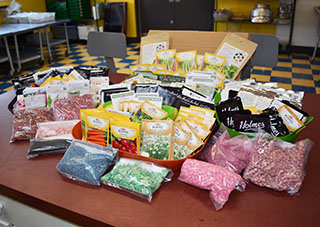
Over the winter we received many generous seed donations for
our Lots of Green Community Garden Support Program here at YNDC.

YNDC works
closely with numerous community gardens in Youngstown which, in addition to
growing fresh local produce, provide educational opportunities to
residents of all ages and often donate produce to aid hunger relief. To
continue to support these critical projects, YNDC sought out donations from
numerous seed companies to provide the gardens with seeds and help them reach
their community goals. We want to thank the following seed companies for
donating to our program and helping us collect over 500 seed packets that will
be distributed to community gardens throughout the city!

Baker Creek Heirloom Seeds

Burpee Seed Company

Holmes Seed Company

Living Seed Company

Southern Exposure Seed Exchange

Sow True Seed

Victory Seed Company

Sidebar images:
Body:

No one is buying a historic mansion on Youngstown’s north side even though it’s down nearly $20,000 from its original price.

Harold Penwell of Western Reserve Realty Group is listing the house, built by the Wicks in 1918, and later sold to the Hirshbergs and Hartzells — all prominent Youngstown names.

The 15-room home at 260 Tod Lane facing Crandall Park has been on the market for about a year. It’s for sale at just $76,900, but needs a lot of work.

The women’s and men’s dressing areas are both big enough to be bedrooms themselves.

Penwell pointed out the handcrafted, original marble and woodwork.

The downstairs bath has the original fixtures, the servant’s quarters has original appliances, and the original boiler is in the basement.

Penwell has shown the house to 60 people and even at the bargain price, no one wants it. The buyer would have to take out a loan to both purchase and fix the house, which needs repairs and renovations just to make it livable.

“If the house is going for $80,000 and the house needs $60,000 in repairs, you have to be able to qualify for a $140,000 loan instead of an $80,000 loan, and a lot of people can’t do that,” he said.

Ian Beniston, who runs the Youngstown Neighborhood Development Corporation, is keenly aware of the importance of Youngstown’s north side mansions. All the houses on Fifth Avenue north of Crandall Park are in good shape.

“The historical and cultural significance, and then the fact they’re on a major corridor,” he said. “Even the ones that line Crandall Park or Wick Park, they’re very prominent in their location, they’re highly visible. So preserving them is important to the city.”

He said only a “very small niche” of people could tackle the large project of renovating the Tod Lane mansion.

To read the full story from WKBN, click here.

Sidebar images:
Body:

Mahoning Valley residents have a new opportunity this year to invest in local agriculture and receive, in return, a weekly share of fresh, locally grown fruits and vegetables throughout the growing season.

The community supported agriculture program, known as the Iron Roots CSA, is being launched by the Youngstown Neighborhood Development Corp., which operates the Iron Roots Urban Farm, 820 Canfield Road.

“We wanted to make our farm more sustainable, and we’d been spending a lot of time and labor to go around to a number of farmers’ markets,” but sales there are unpredictable, and unsold produce has to be composted or donated, said Liberty Merrill, YNDC’s land reuse director, explaining part of the rationale for forming the CSA.

“In a CSA system, everything’s actually pre-sold, and people are investing in the farm,” she added.

“The idea is that you are investing in, and being a part of, our local agriculture system,” Merrill said. “It’s a commitment to eating healthy.”

The new CSA was launched by YNDC, in part, because of last year’s closing of another CSA, known as GROW Youngstown, which had as many as 150 members, she added.

“We wanted to make sure to serve their [former] customers,” Merrill added.

Ian Beniston, YNDC executive director, said the organization decided to start the CSA “as another avenue to offer fresh, locally-grown produce right here at our farm to the community and to have an additional sustainable revenue source for the farm.”

The CSA “makes us less reliant on grant funding,” he added.

“You’re getting a great value in the amount of produce that you’ll buy, but you’re also contributing to the support of the Iron Roots Urban Farm and the Youngstown Neighborhood Development Corp. and our mission, not only to provide healthy food across the city, but to stabilize and revitalize neighborhoods,” Beniston said of CSA membership.

CSA members are motivated by their desire to receive fresh produce, support local agriculture and know where their food is coming from, Merrill said, noting that all of the money exchanged in the program stays local.

The CSA will provide a weekly share of fresh vegetables and fruit to subscribers for 20 weeks beginning in mid-June.

The Iron Roots CSA’s nonrefundable share price is $650 for the season, which must be paid in full by June 13.

A discounted fee of $600 is available for those who pay in full by Friday.

Nonrefundable payment in full in advance “allows us to plan for our season up front,” in terms of acquiring supplies and staffing the farm, Merrill explained.

For information or to sign up, call 330-480-0423, Ext. 2.

In a CSA, farmers don’t have to wait until crops are harvested to generate revenue.

Members assume risks concerning crop yield and quality, but Merrill said those risks will be reduced in the Iron Roots CSA because it will buy produce from other local growers.

Members may pick up their produce shares at the Idora Neighborhood Farmers’ Market, Warren Farmers’ Market or Catullo Prime Meats in Boardman.

Shares are intended to be sufficient to supply a family of four, Merrill said.

A limited number of half shares may also be purchased for $325, with half-share purchasers getting their produce every other week, she added.

In June, share boxes will contain early-season items, such as garlic, greens, strawberries, and radishes. In July and August, they’ll contain tomatoes, peppers, eggplants and green beans. Later in the growing season, watermelons, apples and squashes will be provided.

The CSA program will support the Iron Roots Urban Farm and its mission to grow fresh produce, support farmers’ markets and promote farming and gardening on vacant land throughout the city, YNDC says.

“I like to support the community and local produce farming,” said Vera Franken, of Austintown, who said she will join the Iron Roots CSA.

“It also gives me a commitment,” to eating fresh vegetables regularly at home, said Franken, who has regularly bought produce grown at the Iron Roots Urban Farm.

“I can go to the Iron Roots Farm and order my arugula, and I have a hard time finding arugula in any local grocery store. That is one of the main reasons I started shopping there because they had some of the produce that other places did not,” she added.

The CSA needs about 120 members to break even financially, Merrill said.

Members will be invited to events, such as potluck dinners, volunteer work days and cooking demonstrations at Iron Roots, and will receive recipe cards and a weekly newsletter, Merrill said.

To read the full story from the Vindicator, click here.

Sidebar images:
, , ,
Body:

On Monday, February 20, the Lowe’s Charitable and Educational Foundation provided YNDC with a $1,900 store credit.

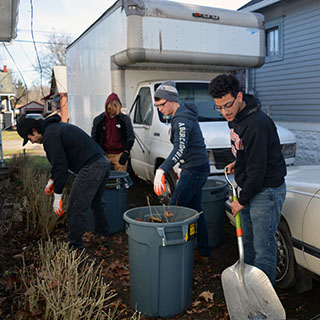
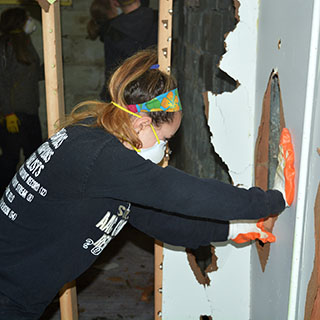
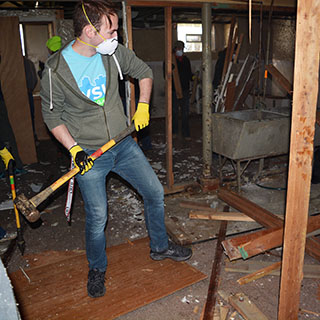
The credit was provided to support YNDC community workdays. Many thanks to the Lowe’s Charitable and Educational Foundation!