Neighborhoods


Strategic Neighborhood Transformation

Sidebar images:
Body:

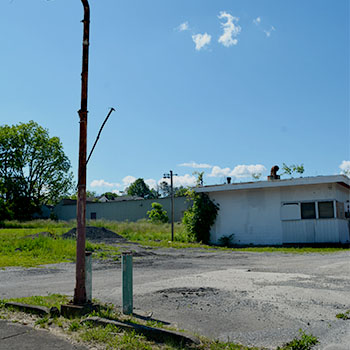
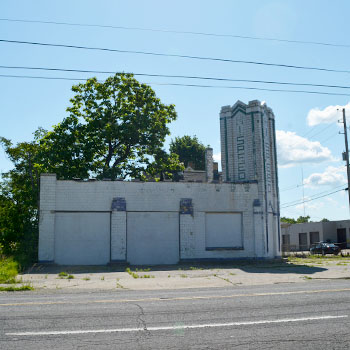
Thousands of dollars in funding
has been granted to the city of Youngstown to help revitalize the abandoned gas
stations in the city.

The funding for brownfield site revitalization is used to
help local governments redevelop vacant and unused properties. The U.S.
Environmental Protection Agency announced Wednesday that 172 communities and
organizations, including Youngstown, will receive the funding to improve its
economy and create an environment where jobs can grow. Youngstown was selected
to receive a $200,000 Brownfields Assessment Grant to collaborate with
community partners to inventory, prioritize, assess and plan for the
development of former gas stations on major streets. The grant will also help
with vacant lots that have petroleum or oil based hazards buried beneath them. Mayor
John McNally says there are about 300 of those lots in Youngstown. "Just
coming down from Boardman this afternoon and driving down Glenwood, there's
probably four to six locations that are on that inventory that have some shell
of maybe an old gas station or there used to be a gas station, but you know
whatever was there on the surface was cleaned away," said McNally.
"It's what's underneath the ground that is the problem, and this grant is
going to help begin the process of trying to solve that." 

Other areas in Ohio that were given approved funding were
Port of Greater Cincinnati Development Authority and Southern Ohio Port
Authority, Portsmouth. Greenville, Pennsylvania was also given a community-wide
grant of $300,000, according to the list of cities granted on the EPA's
website. Greenville's grant will be used to conduct environmental site
assessments and support community outreach.

To read the whole story from WFMJ,
click here.

Sidebar images:
Body:

The City of Youngstown is
receiving a grant from the U.S. Environmental Protection Agency to help get rid
of abandoned gas stations around the city.

The $200,000 Brownfield Community-wide
Hazardous Substances and Petroleum Assessment Grant will clean up some of the
neighborhood eyesores. Four years ago, the Youngstown Neighborhood Development
Corporation found over 300 sites. The city hopes to address contamination and
encourage redevelopment at these sites. The money will pay for the city to have
the underground storage tanks removed and for the land to be developed. This is
the fourth time Youngstown has applied for the assistance from the EPA.

To read
the full story from WKBN, click here.

Sidebar images:
Body:

The fourth time proved to be the charm,
proponents of a $200,000 brownfield assessment grant said after learning the
city’s application for the funds has been approved.

The U.S. Environmental
Protection Agency announced Wednesday that it has awarded the assessment grant
to the city, which had unsuccessfully applied for the funds three times before.
The city will use the $200,000 to fund an updated inventory of petroleum
brownfields, set priorities for brownfield sites, conduct at least 24 Phase I
and about 16 Phase II environmental site assessments, and prepare cleanup plans
for up to three high-priority sites, according to state documents. Youngstown
was among 172 communities and organizations nationwide that were awarded brownfield
grant funds yesterday. “These grants leverage considerable infrastructure and
other investments, improving local economies and creating an environment where
jobs can grow,” U.S. EPA Administrator Scott Pruitt said in announcing the
grants. Work in Youngstown will focus on former gas stations, car dealerships
and dry cleaners – along the city’s main corridors, Mayor John McNally said. “We
know there are probably four or five different sites on Glenwood Avenue,” he
said. “On every major corridor, there are several sites that need to be cleaned
up.” Three years ago, Youngstown Neighborhood Development Corp. conducted a
citywide survey of “every possible site” that could have an underground storage
tank and identified more than 300, reported Ian Beniston, YNDC executive
director. “We need to get these sites cleaned up if we’re going to attract
economic development and investment to these neighborhoods,” Beniston remarked.
“We have to have land that’s assembled but we also need to have land that’s
cleaned.”

To read the full story from The Business Journal, click here.

Sidebar images:
,
Body:

Thursday, June 1, 2017

On Wednesday, May 31, the USEPA announced the award of a $200,000 USEPA Assessment Grant to the City of Youngstown.

The award will be utilized to complete Phase 1 and Phase 2 environmental assessments of priority sites along neighborhood commercial corridors with possible underground storage tanks as identified in the 2013 City Unseen Youngstown's Abandoned Underground Storage Tanks Study. Project partners include: Eastgate Regional Council of Governments, Youngstown State University Regional Economic Development Initiative, Western Reserve Port Authority, Regional Chamber, Mahoning County Land Bank, YNDC, and multiple neighborhood groups.

Sidebar images:
,
Body:

Friday, June 2, 2017

University
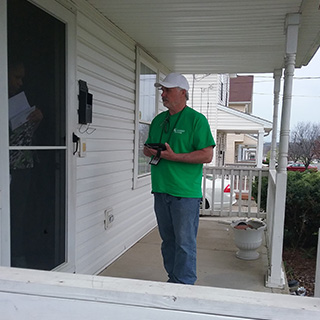
of Michigan is hiring Property and Community Surveyors. All positions will be hired directly by University of Michigan, but the positions will be based at Youngstown Neighborhood Development Corporation and all work will be within the City of Youngstown.

These positions are $13 per hour, 30-40 hours per week,
Monday through Saturday. These positions do require a background check, that
you hold a legal driver’s license, have your own vehicle, and be able to walk
long distances. There is no reimbursement for gas or mileage.

Daily
Activities will include rating the physical appearance of property parcels, recruiting
participants for the survey, gathering consent forms from study participants,
and administrating surveys at designated neighborhoods within Youngstown. Applicants
should possess a high school diploma or GED, be able to work in teams, have
strong attention to detail, and possess good interpersonal, written, and verbal
communication skills.

To apply, please send a resume and 3 references to Desiree
Liwosz at liwoszd@umich.edu

Sidebar images:
Body:

What comes to mind when someone says the Mahoning Valley? The region's post-industrial downfall? Its shifting
political alliances? The rampant opioid epidemic? Those are all valid stories about the region. But, despite
what national media coverage might lead you to believe, they're not the only
stories.

The region still faces plenty of challenges, but in both
Youngstown and Warren, efforts to revitalize the cities at the heart of the
Mahoning Valley are underway, led by entrepreneurs opening new businesses and
renovating buildings, and by neighborhood development corporations cleaning up
blight. It's taken a long time for the region to even consider
rebuilding after its major manufacturing base left. After "Black
Monday" in 1977, when Youngstown Sheet and Tube Co. announced thousands of
layoffs, the city of Warren didn't fall into a depression overnight. It was
more "gradual," said Michael D. Keys, community development director
for Warren. "I think at the time, a lot of people said, 'Oh, it's
going to come back,' " Keys said. "And there was sort of that denial,
so like, with grief. You know, the 10 stages of grief, the 10 stages of
economics. And I think what we're seeing now is that we've reached the bottom a
while back, and we're now on our way up." Disclosures up front: I was born in Warren and lived there
as a child before my family moved to one of the city's suburbs about 10 minutes
away. I attended a Catholic elementary school, and church, in Warren. I got my
start as a reporter at the Tribune Chronicle, first as a writer for its teen
page and then as a freelancer throughout college. I've spent a lot of money at
the Mocha House. That's why I've been confused by the post-election trope
that, in an effort to explain why so much of the Mahoning Valley turned away
from the Democrats, depicts the region as a wasteland of industrial ruin. That
might have been true 30 years ago, but for those of us who missed the region's
manufacturing heyday and instead compare the Mahoning Valley to what it was one
or even two decades ago, the difference is striking.

For the full story from Crain's Cleveland Business, click here. 

Sidebar images:
Body:

The 13th annual Warriors Inc.
Parade marched down the south side of Youngstown Saturday.

Community groups and
politicians passed out candy and raised awareness for their causes. Students and
church groups also marched. “It’s an awesome turnout,” said Wendy Robinson,
parade organizer. “Every year we are very prayerful that we have a great
turnout. The weather held up and we have an awesome turnout, so we are
excited.”

“The purpose is to show the resources that are in the
Mahoning Valley,” she added. “There are so many people that aren’t aware of the
resources throughout the Mahoning Valley. So we want to bring the people to the
resources and the resources to the people.” The parade marched down Market
Street from Midlothian to Delason, and ended at the South Field House.

To read
the full story and see the video from WKBN, click here.

Sidebar images:
Body:

CEO Krish Mohip’s new
summer school program has almost tripled last year’s student participation.

In
summer 2016, Timothy Filipovich, chief of academics, accountability and
assessment, said about 460 students participated and this summer 1,280 have
registered so far. This year’s summer school will offer three programs in an attempt
to fit each child’s need. Summer school is free. It includes enrichment,
education and intervention opportunities as well as free meals and
transportation. One of the programs is for senior students who didn’t pass the
Ohio Graduation Test requirements to receive a diploma. “We call it an ‘OGT
Blitz,’” Filipovich said. “This is our way of offering opportunity for
intervention.” The program is running from 8:30 a.m. to 12:30 p.m. until Friday
at Choffin Career and Technical Center, 200 E. Wood St. Another summer school
program is for high-school students who are behind on their credits to achieve graduation
on time. “They will take courses to make up credits online in the APEX
curriculum,” Filipovich said. The program will take place from 8:30 a.m. to
12:30 p.m. at Choffin, five days a week, now until June 30. It is open to any
student in grades nine through 12 who need to make up credits. Another option
in Mohip’s new summer school program for all students is intervention or
enrichment opportunities for the state-mandated American Institutes for
Research tests. The AIR tests require students to accumulate a minimum of 18
total points on a number of tests to graduate. “Some students don’t have enough
points, so this is our way to offer intervention to get them there,” Filipovich
said. Included in this intervention is the opportunity to retake tests from
July 10-28. Each summer school program comes with free lunch and breakfast for
all students. Younger students, however, have longer summer school days – from
8:30 a.m. to 4 p.m. The full-day programs mirror the high schools’ summer
school programs with instruction in the morning hours, but in the afternoon
they will have the chance to experience a number of different activities. Seventh-
and eighth-graders, whose summer school will take place at Choffin to explore
career opportunities, help out with community service projects at Mill Creek
Park and the Youngstown Neighborhood Development Corp., go to see movies at
Boardman Movies 8 and visit area museums. “We want school to be a place they
want to come to provided we have the right enrichment activities,” Filipovich
said. If a parent elects not to participate in enrichment – second half of the
day – they have to arrange transportation for their child. Elementary-school
students – kindergarten through sixth grade – will have similar instruction
with the exception of third-graders, who will focus on getting prepared to meet
the Third Grade Reading Guarantee, Filipovich said. The Third Grade Reading
Guarantee is a program to identify students from kindergarten through third
grade who are behind in reading, according to the Ohio Department of
Education’s website. “Schools will provide help and support to make sure
students are on track for reading success by the end of third grade,” he said.

To read the whole story from The Vindicator, click here.

Sidebar images:
Body:

Danville officials are
getting closer to starting up a nonprofit group focused on neighborhood stabilization
and preventing blight.

The Danville Neighborhood Development Corporation will
open up in the next few weeks in the Center for Housing Education building at
Franklin and Monument streets, City Manager Ken Larking said. “We felt like it
would be a good complementary use of that building,” Larking said. An executive
director has been hired within the last month to lead the organization, said
Deputy City Manager Earl Reynolds. The city hopes to announce who it is in the
next couple of weeks, Reynolds said. The city has committed an initial
first-year investment of $200,000, with part of the money to be used to map out
a strategic plan during the organization’s first several months, Reynolds said.
Officials will also come up with a first-year budget for the group. Board
members, the new executive director and city officials will travel to
Youngstown, Ohio, to take a look at its Youngstown Neighborhood Development
Corporation. It’s considered one of the best models on the East Coast for such
a group, Reynolds said. A program to help streamline Danville’s blight removal
process was approved by the General Assembly and Gov. Terry McAuliffe in 2016. The
measure allowed Danville to create Virginia’s first land bank program enabling
the city to auction off properties and streamline the blight removal process in
the city. The corporation will hopefully be that land bank, Reynolds said. “It
gives us another tool to address blight in our city,” City Councilman Lee
Vogler, who proposed the legislation to Del. Danny Marshall, R-Danville, for
the 2016 General Assembly session, told the Register & Bee in February. The
group was recommended by a housing study — by CZB, LLC — commissioned by the
city in 2015. It has the capabilities and flexibility to act more quickly, concentrating
their efforts on stabilizing neighborhoods and improving houses throughout the
city, Larking said. The corporation also is able to leverage private money. It
will get city money to start off, but will hopefully be able to handle future
efforts on its own, Larking said. It would be partners with the city, with
Danville playing a role through regulations and enforcement, Larking said. The
land banking legislation enables the city to hold property and resell it to
developers and new homeowners with the goal of responsible homeownership,
Larking said. Volger, City Councilman James Buckner and then-Mayor Sherman
Saunders pushed for the legislation, with Marshall leading the effort at the
state level, Larking said. “The corporation will be able to use the legislation
as a tool to meet its mission,” Larking said. Danville has about $1 million
requested for blight eradication in its 2017-18 budget.

To read the full story
from Go Dan River, click here.

Sidebar images:
, , , , ,
Body:

Monday, June 5, 2017

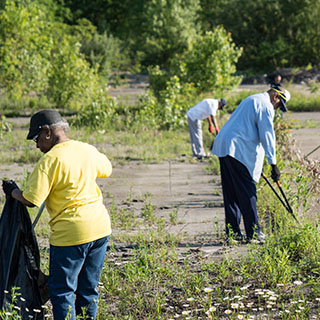
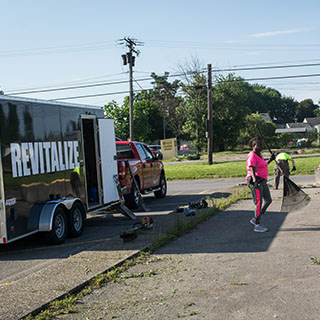
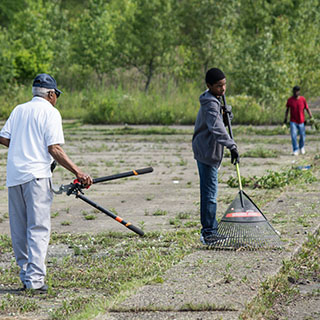
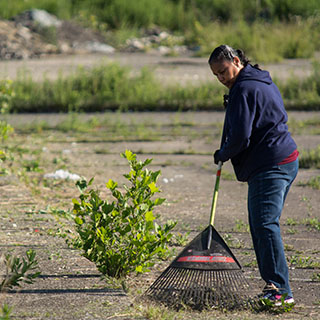
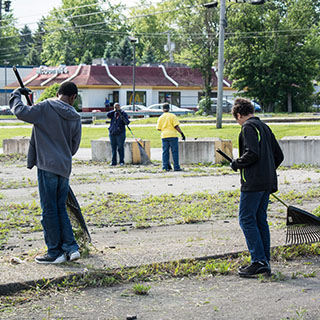
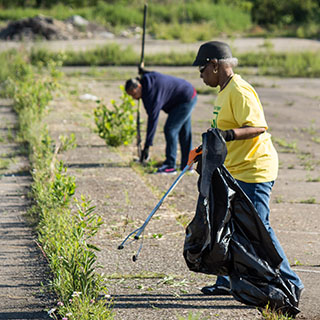
On Saturday, June 3, ten volunteers from the Lincoln
Knolls Community Watch and the Lincoln Knolls neighborhood helped clean up the vacant
parking lot to the west of the Lincoln Knolls Plaza.

Overall, 5 cubic yards of debris were removed and weeds were cleared from the entire vacant lot. Special thanks to the Lincoln knolls Community Watch for helping us REVITALIZE!